A good 30-day challenge is one you can do on your worst day of the month, that you can answer yes or no to every night, and that you’d be pleased to still be doing in March. Most lists of ideas fail the first test. The ones below are grouped by what they change, and each comes with the small version that survives a bad day.
What makes an idea work
Before the list, the three tests. An idea that fails any of them will be abandoned around day nine, which is when every challenge gets hard.
- Binary. At the end of the day, did you do it? “Eat healthier” can’t be answered; “a vegetable at lunch” can.
- Daily-sized. It fits in a normal day without rearranging it. If it needs a free evening, it’s a project, not a challenge.
- Has a floor. A minimum version that still counts: one page, two minutes, one push-up. The floor is what keeps day nine from being day zero.
And one honest caveat. Thirty days is a good length for a challenge, not proof of a habit; the research on how long a habit takes puts the median at about two months. Treat day 30 as a checkpoint: keep it, change it, or drop it on purpose.
Health and body
| Challenge | The floor on a bad day |
|---|---|
| Walk 20 minutes | Walk around the block |
| 10 push-ups a day | One push-up |
| Stretch before bed | One stretch, held for 30 seconds |
| Drink a glass of water before coffee | The glass, even if it’s small |
| No sugar in drinks | Still counts if the food had some |
| In bed by a set time | Lights out within 30 minutes of it |
| A vegetable with lunch | Any vegetable, any amount |
| Take the stairs | One flight, then the lift |
Sleep is the one with the biggest knock-on effect, and the one most people pick last.
Mind and attention
| Challenge | The floor on a bad day |
|---|---|
| Read 10 pages | One page |
| Meditate 5 minutes | Three breaths, eyes closed |
| Journal three lines | One line |
| No phone in bed | Phone charging outside reach |
| No social media before noon | Not before breakfast |
| Write down tomorrow’s top three tasks | The top one |
| Ten minutes outside without headphones | Five |
Skills
| Challenge | The floor on a bad day |
|---|---|
| Practise a language for 15 minutes | One lesson, or ten flashcards |
| Draw one thing a day | A thirty-second sketch |
| Play an instrument for 15 minutes | One run through a scale |
| Write 300 words | One sentence |
| Learn one keyboard shortcut and use it | Use yesterday’s |
| Cook one meal from scratch | Anything not reheated |
Skills challenges are where a floor matters most, because the bad days are when motivation is lowest and the work feels least rewarding.
Money and home
| Challenge | The floor on a bad day |
|---|---|
| Log every purchase | Log it before bed from memory |
| No spending on one category (takeaway, coffee) | Same rule, no floor: it’s a no |
| Ten-minute tidy before bed | One surface |
| Get rid of one item a day | Put one thing in a box by the door |
| Make lunch instead of buying it | Bring something, anything |
| Wash up before bed | Clear the sink |
“No” challenges (no takeaway, no alcohol) don’t have a floor in the same way. They work better when the rule is precise: “no takeaway on weekdays” survives a birthday dinner; “no takeaway” doesn’t.
Relationships
| Challenge | The floor on a bad day |
|---|---|
| Message one friend you haven’t spoken to lately | A one-line message |
| Phone a parent or sibling | A voice note |
| Thank someone specifically | In writing, one sentence |
| Phones away during dinner | Face down, sound off |
Picking one, and only one
The list is long so you can find the right one, not so you can do six. One challenge has your attention; four have a quarter each, and a bad Wednesday takes them all down together. The reasoning is here, but the short version is: start one, add a second only when the first stops needing a decision.
Two ways to choose:
- The irritation test. Which thing, if you did it every day for a month, would remove the most friction from the other eleven months? Usually sleep, tidying, or the phone.
- The identity test. Which would you like to be able to say you do? “I read most days” is a better reason to start than any statistic.
Not every challenge is daily
Some of the best ones aren’t: running three times a week, the gym on weekdays, a long call with a friend on Sundays. Forcing them into a daily grid means either doing too much or “failing” on purpose four days a week. Tracking a habit that isn’t daily covers how to schedule them so rest days don’t count against you.
Keeping track of thirty days
The tracker matters less than people think. What it has to do is show you the month at once, so you can see that you’ve done nineteen of twenty-two days rather than only that you missed yesterday.
Paper works: a 30-square grid on the fridge. An app adds reminders, and the part paper can’t do well, which is not counting rest days as misses.
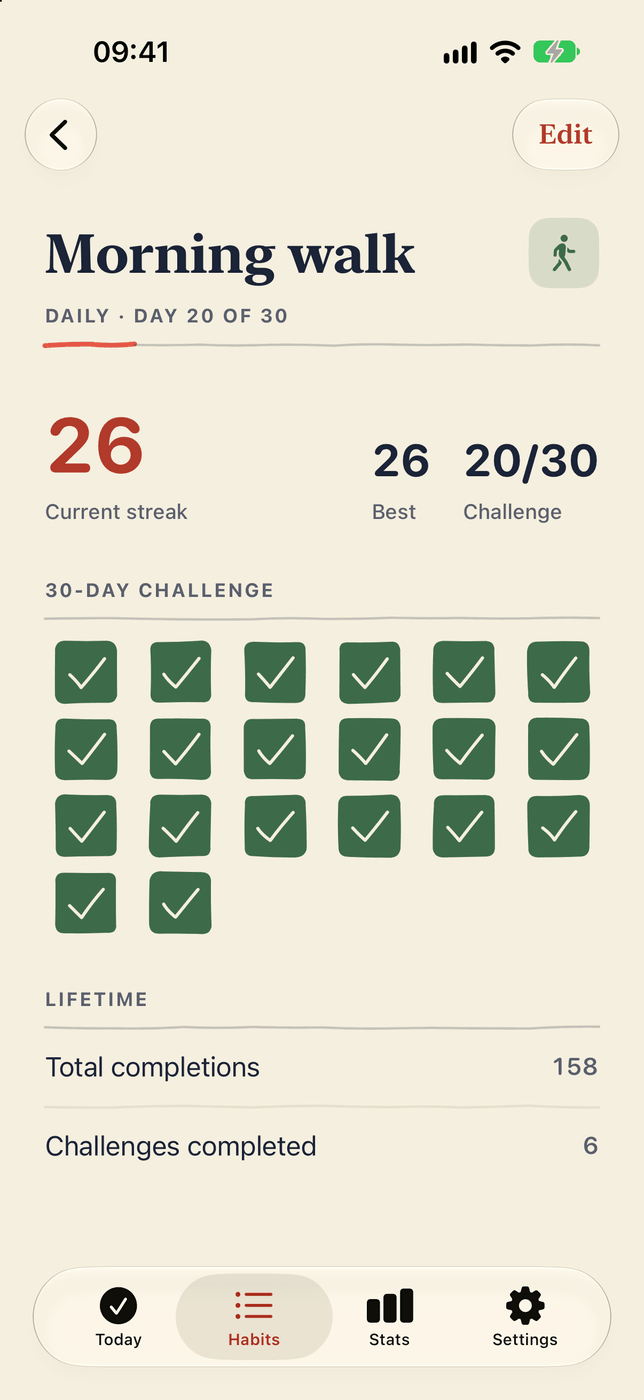
Ours starts from templates (walk, read, meditate, drink water, journal, no phone in bed and a few more), or a habit of your own. Three habits are free, which is more than this article thinks you should start with.
When you miss a day
You will. A missed day in a thirty-day challenge isn’t failure; two missed days in a row is the start of stopping. The rule that works is never miss twice. If you’ve already missed several, here is how to restart without starting the whole thing over.